
 Back to moment
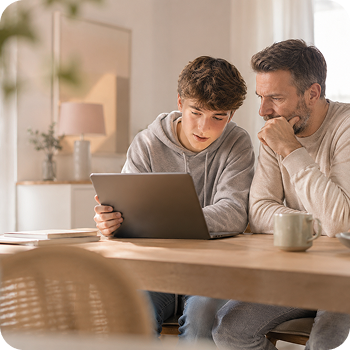
A Family AI Moment
Your child created or shared a fake image of a real person using AI.
Someone sent you a screenshot. Or your child showed you something they made. Or you found it on their phone. Either way, you are looking at a fake image of a real person, and your child is involved.
Whether they made it, shared it, received an image of themselves, or simply saw it, start here. Don't share it further. We'll go step by step.







Find out what happened, calmly.
You may not yet know whether your child created the image, shared it, received it, or simply came across it. Start with understanding, not assumptions.
If the image is sexual, threatening, hateful, humiliating, or making a child feel unsafe, treat it as a safety issue first.
Tap Emergency & Safety for the steps and support lines.

AI conversation starters
If the image has been shared, help your child remove or report it on the relevant platforms together.
Do not forward the image or share it further. Keep the device or message available if it's safe to do so, and contact the school or relevant safeguarding support for guidance. Tap Emergency & Safety for the steps.
If they say it was just a joke.
"I hear you. But here is the thing. A joke works when everyone is laughing. The person in the picture didn't get to choose. That's the part that matters." Then: "If someone made this about you, would you think it was funny?"
If they say they did nothing wrong.
"I understand it doesn't feel serious to you. But once an image is shared online, you cannot fully take it back. It can be screenshotted. It can spread. It can follow someone for a long time." They may not have meant harm. The person in the image still never agreed to it.
If it didn't go as planned.
For when you already reacted with anger or punishment before understanding what happened: "I should have asked before I reacted. I want to understand what happened so we can address this properly. Can we start again?" Coming back after you got it wrong teaches your child more than getting it right the first time.

What to know
A fake image of a real person can cause real harm if the person did not agree to it.
AI tools can make it easy to create, alter, or manipulate images. A child can swap a face, edit a photo, or generate a realistic image in seconds. Some tools are designed to make this feel playful. Some are built into platforms children already use. To a child, it may feel like a joke, a meme, or a creative experiment.
AI tools can make it easy to generate a realistic fake image of a real person in seconds. Some tools make this feel playful or creative. But a fake image of a real person can damage their reputation, cause stress, create problems at school, and in some cases have serious consequences for the person in the image, and for the person who made it.
For the child who shared it, it may feel like forwarding a joke. But sharing extends the harm. They may not have created the image, but they chose to pass it on. As per the UAE Cyber Security Council, sharing, posting, or forwarding unverified deepfake images, videos or AI-altered photos is a serious criminal offense.
Receiving or seeing a fake image does not make your child responsible for it. What matters is what they did next; whether they forwarded it, saved it, or said nothing. It is important to have a conversation with your child if such a scenario comes up.
They need to know it was not their fault, they did the right thing by telling you, and you will help them manage this situation. Do not forward the image. Keep the device or message available if it is safe to do so.
What changes with age
The conversation looks different at each stage of growing up.
If your child has created, shared, received, or been included in a fake AI image of someone they know, what it means and how to respond depends on their age.
Which age is your child?
Gen DubAI is designed for families with children in late childhood and early adolescence.
These years are when many children begin using digital tools more independently and when parents and caregivers can still strongly shape habits, boundaries, and judgment.
The age range is informed by broad developmental research. Around 11 to 12, many children begin moving from more concrete thinking toward more abstract reasoning. By 13 to 15, children often seek more independence, rely more on peers, and encounter more complex digital situations.
This does not mean guidance is no longer needed after 15. It means this guide is focused on the years where early family guidance can have strong preventative value.
Every child develops differently. Use the age guidance as a starting point, not a strict rule.
Build perspective-taking.
At this age, a child may not understand what they have done. They may have used an app to put a friend's face on something funny without thinking about how that friend would feel. They may not know the image looks real to other people. They may not understand how quickly it can spread.
The conversation is about helping them imagine the other side:
AI conversation starters
What they need to understand: real people can be hurt by fake images. The person in the image should have a say. Sharing can cause harm, even if they meant it as a joke. And they should come to an adult if they see or receive something like this.
Add disclosure, peer pressure, consequences.
At this age, many young people may understand that something feels wrong, but peer pressure, group chats, or the feeling that "everyone is doing it" can make it harder to pause. The conversation shifts from "Do you understand why this matters?" to "What made it hard to stop or speak up?"
AI conversation starters
Useful questions
At this age, consequences need to be part of the conversation: social, school, and in serious cases legal or safeguarding consequences. But the tone still matters. If your child feels there is no way back, they may hide more. If they feel you are serious and still willing to help, they are more likely to tell the truth and repair what they can.
Something to try
The Swap Test.
A conversation that helps your child understand why fake images of real people are different from other jokes or creative experiments.
One conversation. No technology needed. Four short questions that build empathy through your child's own reasoning.
Ask them to swap places
"If someone made a fake image of you and shared it with your class, how would you feel?"
Ask about intent
"What if they said it was just a joke?"
Ask what makes a joke fair
"What's the difference between a joke you both laugh at and a joke only one person laughs at?"
Give them a question they can think about
"Before you make or share an image of someone, how do you think they would feel about it?"
A child who can imagine what it feels like to be on the receiving end is more likely to pause next time.
If your child has seen an image and isn't sure whether it's real, try a reverse image search together once. Many AI-generated images still leave traces.
This builds a concrete skill your child can use the next time something looks too perfect. Looking real proves nothing. What protects your child is knowing it might not be.
Before you go
Pass it on.
This works best when every adult around your child says the same thing. Who's with them when you're not?
Send this card to another parent.
Partner, co-parent, guardian or a friend
Send this message to the child's caregiver.
Nanny, tutor or baby sitter
Send these directions
[Child's name] may use AI apps that change or create images of people.
If you see them making or sharing a picture of a real person who did not agree to it, please ask them to stop.
Do not delete anything.
Please tell me the same day.
Help us make this better.
Please do not include personal details. Information submitted through this form is subject to our terms of use.
References

This moment draws on Gen DubAI parent research and online safety research about deepfakes, AI-generated sexual images, cyberbullying, and image-based harm. Internet Matters highlights how generative AI has made realistic fake sexual imagery easier to create, while Common Sense Media warns that children can misuse generative AI to create fake or harmful content. The emergency and safety instructions in this moment are aligned with UAE law on child digital safety and protection, specifically Wadeema's Law (Federal Law No. 3 of 2016), the Cybercrime Law (Federal Decree-Law No. 34 of 2021), and the Child Digital Safety Law (Federal Decree-Law No. 26 of 2025). They have been vetted by the Community Development Authority (CDA) in Dubai.


